Work Library
Practical Tools for distributed teams who want their work to count.
Work falls apart between moments of attention: decisions are revisited, progress takes a step backward, and good work stays invisible.
This library addresses those problems directly.
Everything here is free. Each tool is designed to cost less than the problem it solves.
If your work goes off-course or comes in late
for team leads and contributors
These tools address the core problem: work that cannot maintain the progress it has built.
Work fails because its context erodes, decisions get revisited, and it stops making progress. This creates work erosion because your effort does not accumulate.
Outcome Statement Worksheet. Clarifies what you are committing to produce before work begins and before conversations go sideways.
- Starter Worksheet (fillable pdf)
- Quick Start Guide – Give Your Work a Memory
Decision Record Guide and Template. When a decision gets made, this is how it stays made. Includes the guide (read first) and the template for creating a record that holds.
- Decision Guide (read first)
- Decision Record Template
Structured Update Template. Replaces status updates that report activity with updates that report movement toward the outcome. (ready-to-copy .docx)
If your updates aren’t communicating
for contributors
Manager Update Guide. A format for communicating progress upward that is short, unambiguous, and easy to act on without requiring a meeting to interpret it.
Making Your Work Count. Distributed contributors do work that their teams don’t see. This system shows how to make outcome progress visible by design.
for team leads
Meeting Upgrade Checklist. Most meetings do not advance work. They recap it. This checklist identifies the adjustments that genuinely move work forward.
- Meeting Upgrade Checklist (Make your meetings work)
If your plans are breaking down midstream
for team leads and contributors
Discovered Effort Guide. When discovered effort changes what’s possible, someone has to make a deliberate choice: adjust the timeline, the resources, or the outcome. This guide runs that conversation cleanly.
Evidence Guide. When teams lose track of what has actually changed versus what is still in motion, this guide helps reconstruct a shared picture of where things stand.
If work is hard to start and hard to sustain
for contributors
Structured Day Launch. (fillable PDF) A daily entry point for contributors who need to protect their best thinking hours. Frames the day before the day frames you.
Request Worksheet. When what you need from someone else is unclear, work stops moving. This worksheet produces a request that is specific enough to act on.
Idea Flow Worksheet. For half-formed thinking that is taking up space. Gets an idea out of your head and into a form that can move forward or be set down deliberately.
The Architecture Behind these Tools
These tools are not isolated templates.
Each one is part of the Momentum Architecture, a methodology that preserves intent, decisions, progress, and learning so work does not have to start over between conversations, transitions, or leadership changes.
The tools work individually. They compound when used together.
When teams adopt even one of these practices, they enjoy fewer reopened decisions, clearer updates, greater confidence in their progress, and more predictable completion.
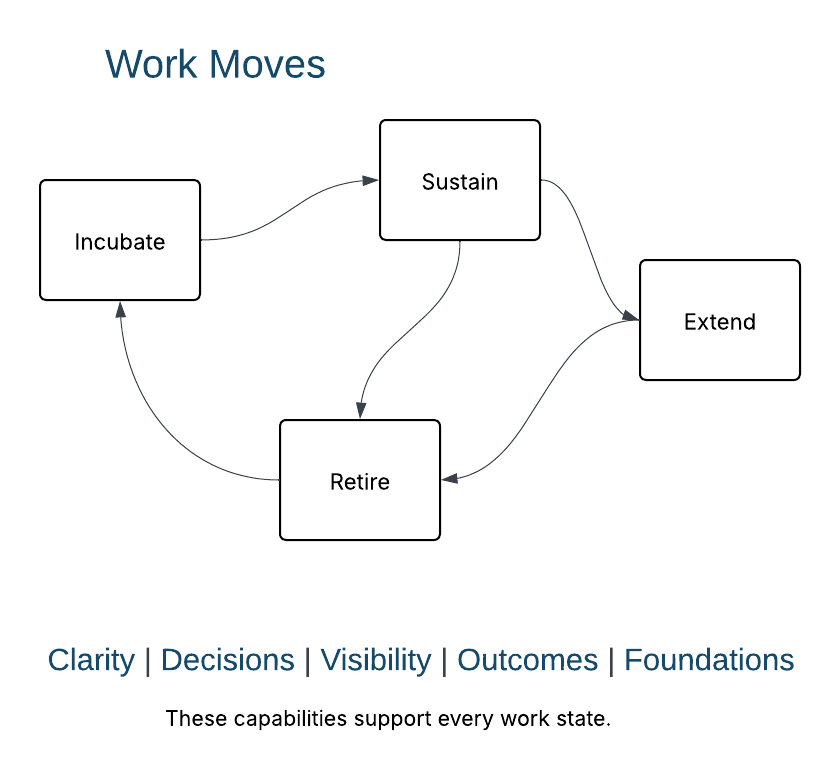
If you want to go further
The library gives you the individual practices. These are the structured paths that put them into a system.
For contributors:
Work that Starts Well and Stays Done – a guided program for building personal work continuity. Learn more
For team and organizational leaders:
Give Your Work a Memory – a structured team-level engagement with direct support. Read about the engagement and apply